
Chapter 2: from the West India Company to the abolition of slavery
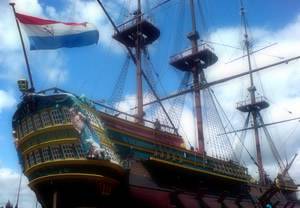 In 1636 the Dutch took over Aruba from Spain. Apart from two short periods of British rule, the island has been part of the Netherlands ever since. This chapter covers the period up to the abolition of slavery in 1863.
The Dutch West India Company
During the war between the Dutch Republic and Spain, the Dutch West India Company (WIC) captured Curaçao in 1634 and Aruba in 1636. The WIC did not use Aruba as a plantation colony but as a supply island: horses, cattle and goats were raised to provide meat for Curaçao and other Dutch possessions.
For more than a century free colonists were not allowed to settle on the island. Only from 1754 did the number of settlers slowly grow, in places such as Savaneta and Noord.
From Savaneta to Oranjestad
Savaneta was the first capital of Aruba. Around 1797 the seat of government moved to Paardenbaai (Horse Bay), a natural harbour on the west coast. To protect the harbour, Fort Zoutman was built there in 1798; it is the oldest building on Aruba. The Willem III Tower was added in 1868, and the fort now houses the Historical Museum. In 1824 Paardenbaai was renamed Oranjestad, after the Dutch royal House of Orange.
British rule
During the Napoleonic Wars the British occupied Aruba twice: from 1799 to 1802 and from 1805 to 1816. After that the island was returned to the Netherlands for good.
Slavery and its abolition
Because Aruba had no large plantations, the number of enslaved people on the island was relatively small compared with Curaçao. Slavery was abolished in all Dutch colonies on 1 July 1863. On Aruba nearly 500 people were freed on that day.
The history of Aruba in four chapters
- Chapter 1: Early Inhabitants and the Spanish
- Chapter 3: Gold, Aloe and Oil
- Chapter 4: Status Aparte and Autonomy
See for yourself
- Oranjestad – Fort Zoutman and the historic centre
- Savaneta – the first capital
Good to know
- Dutch takeover: 1636
- British occupation: 1799–1802 and 1805–1816
- Fort Zoutman: built in 1798
- Abolition of slavery: 1 July 1863
Historical sources do not always agree on exact dates and numbers; this overview follows the most widely supported accounts.
See also: the history of Aruba.
Last updated: September 2026.